JanBask Training
Introduction
The market for cloud testing is expected to grow a CAGR of more than 13% over the forecast period (2021 – 2026). The demand for cloud testing is going high owing to the capabilities of cloud-sourcing technology in software testing activities to do quality assurance (QA) and to remove errors.
Further, as companies are developing rapidly, it has become even more complex for organizations to maintain their in-house testing facility, and cloud testing has emerged as a perfect solution.
Go through the whole guide to get in-depth knowledge of cloud performance testing, what can be done in cloud-based performance testing, what benefits we derive, etc., along with top cloud testing tools. Consider joining the Performance Testing Training Program to outshine your career in testing.
QA Software Testing Training
- Detailed Coverage
- Best-in-class Content
- Prepared by Industry leaders
- Latest Technology Covered

A Glimpse of Cloud Performance Testing Fundamentals
The quality assurance process for software includes performance testing. Businesses use this method to evaluate a software application's performance and stability under various workloads.
The performance testing of software programs running in the cloud is called cloud performance testing. The cloud offers a lot of processing, storage, and networking resources where applications may be scaled. Besides, the additional resources help to accelerate the speed of your application.
With cloud performance testing, you can identify performance bottlenecks and figure out what is required to handle peak workloads by determining how well an application will function—or is functioning—in a cloud-hosted environment.
Cloud performance testing aims to test applications for functional and non-functional requirements, ensuring that everything functions properly under the specified and anticipated demand.
Best Practices of Cloud Testing to Enhance Your Application
The way that end users deploy, monitor, and use programs is revolutionized by cloud computing. Applications may be scaled based on your best needs because of the cloud's limitless supply of computing, storage, and network resources. You can use the following best practices for cloud performance testing to enhance the performance of your cloud-based applications:
Review the latest load tools :- Some of the load-generating apps that are currently accessible work on various cloud platforms, but it's crucial to ensure that these tools are compatible with the application design. To understand the load restrictions, some key elements you should examine include bandwidth simulation, upload/download speeds, and making sure the tool is accurately represented to understand the load limits.
Embrace automation and schedule:- Always choose load-testing tools that include scheduling, reports, and analytics. DevOps teams can avoid overworking production systems by doing this while they plan and execute ongoing load tests. Following completion of the testing, these technologies provide thorough results with the relevant parties to give everyone a clear understanding of how the app is performing.
Test the firewall inside/outside :- It can be challenging to identify the core cause of some possible reasons for poor app performance. To identify and address performance bottlenecks, ensure to include testing both inside and outside the firewall in your load test plan.
Simulate real conditions:- A realistic scenario might not be created by merely subjecting the app to heavy loads till failure. The same applies when using similar hardware, browsers, bandwidths, or operating systems. The environment for load testing should support a wide range of test scenarios while sustaining a constant user load under diverse settings.
Prioritize the errors:- Prioritizing the bugs will help you get the most out of your cloud performance testing. Take the necessary steps to maximize the return on investment from your testing efforts after you have the relevant data and insights.
Focus on users along with servers:- Performance tests typically concentrate on servers and clusters. But the human component should also be measured in these examinations. Don't forget to test the UX when performing cloud performance tests for specific test results.
QA Software Testing Training
- No cost for a Demo Class
- Industry Expert as your Trainer
- Available as per your schedule
- Customer Support Available

Advantages of Cloud Performance Testing
Cloud testing emerges as a software development life-cycle (SDLC) winner. The importance of performance testing is enormous. Below we have highlighted the key advantages of cloud testing to show why cloud testing is the need of the hour.
- Affordable and Cost-Effective: It requires considerable money to test software and fix any discovered bugs. In contrast to the traditional testing approach, cloud testing allows a company to save 70% on testing costs. Compared to traditional solutions, cloud-based testing technologies save money on operational and IT management expenses. The testing procedure is expedited through cloud testing.
- Unlimited Cloud Availability: A corporation must invest in hardware and software infrastructure as a fundamental prerequisite for every business or QA team conducting testing. Accessing resources from any device, at any time, and from any location is another advantage of the cloud. The testing teams' environment is distinct from the clients' environments. The team finds it difficult to meet the need as a result.
- Time Saving: Cloud performance testing saves time while also being cost-effective. You can execute an application simultaneously on several physical devices using cloud-based testing, regardless of the time or place. The tester can devote more effort to resolving flaws as a result.
- Customizable: You can test various courses on a system using the cloud. The QA team does load and performance tests in various scenarios to see how various combinations and permutations will impact the software on a particular device. Because of this flexibility, the team can decide what needs to be done to improve the software's compatibility with a particular device.
As businesses transition to agile cycles, cloud performance testing offers several benefits. Consolidating this methodology into QA test management procedures will enable you to move more quickly and achieve significant benefits. If you are new to this field, have a solid understanding of the basics of testing with Software Testing and Software Test Life Cycle.
Types of Cloud Performance Testing
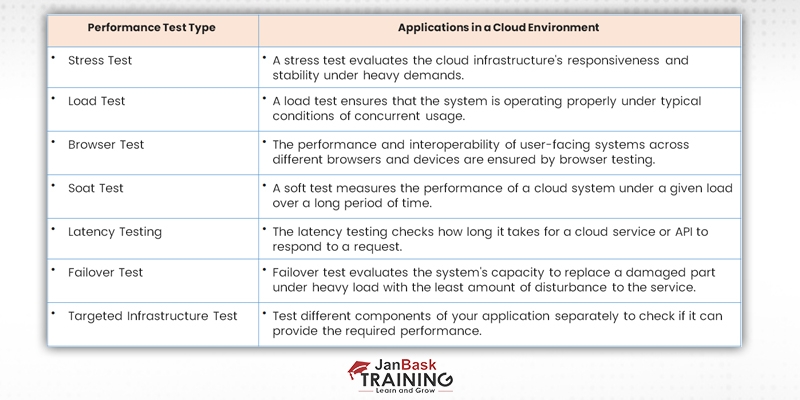
The table below presents the different types of performance testing used in a cloud environment-:
Top Cloud Performance Testing Tools
Here, we've compiled a list of the best tools that help automate cloud performance testing procedures while streamlining and expanding the process. You can choose any software performance testing tools as per your needs and budget and categorize them depending on the applications you want to test –
SOASTA CloudTest – With SOASTA CloudTest, you can do four different types of automated performance and automated functional testing in the cloud. It also offers real-time data analytics and seamless integration of testing, monitoring, and reporting modules to enable effective cloud testing methods.
LoadStorm: This additional cloud testing tool is ideal for evaluating the load-carrying capacity of mobile and online applications. It is both user-friendly and reasonably priced. With the ability to simulate several users to push an app to its breaking point, LoadStorm provides tremendous scalability. On LoadStorm, load-testing scenarios can be modified based on the particular requirements of an application.
Nessus: Nessus is one of the best cloud performance testing tools for checking for flaws, missing components, and improperly or poorly configured features in various hardware, including firewalls, cloud infrastructure, and other devices. Testing teams and developers can use it to find dangerous components like malware and online services connected to questionable sources.
These were some of the best cloud performance testing tools you should use when getting involved in cloud performance testing. Also, become part of our JanBask Testing Community.
Conclusion
This was all about cloud performance testing, including tools, best practices, and other information. Any organization that wants to achieve the anticipated ROI while providing end users with outstanding customer experiences needs a high-performing application. Digital firms may develop high-performing, scalable systems without going over budget or missing deadlines by using the cloud for performance testing. The developers and testers will also find a performance testing certification course to be of great use. You can join the JanBask Training's Performance Testing Training Program if interested.