Introduction
Imagine a world where machines can create, invent, and bring new ideas to life. Welcome to the age of generative AI, whereby innovation and creativity are advancing like never thought possible. The potential these Generative AI tools present lies in the changing of industries, art forms, and even the fabric of society altogether. Now, in this blog, we are going to deeply penetrate this amazing world of generative artificial intelligence and a detailed list of generative AI tools with insights into some of the latest developments, applications, and implications.
Did you know? According to Statista, the transformative capability of generative AI tools has boosted
- efficiency in content creation by 40%
- creative output by 75%
- workflow automation by 90%
What is generative AI ?
So, what is Generative AI? Let’s help you understand the concept first. It is a subdomain of AI that deals with teaching machines the ability to create content. Traditional AI works with predetermined rules, but generative AI has the ability to learn from its data and spontaneously generate such content.
This technology uses complex algorithms that, most of the time, use neural networks to understand such patterns and produce outputs that can mimic human-like creativity.
What makes generative AI important is its potential to really transform industries. From content creation to software development, generative AI tools are opening ways for higher efficiency, creativity, and innovation. Companies are thus highly adopting the tools to smoothen their process flows, reducing manual efforts, and unlocking new possibilities that at one time were unimaginable.
What's behind the sudden hype of gen AI tools?
Although a growth curve, generative AI has been on the radar since 2020, according to Gartner's Hype Cycle for Artificial Intelligence. We at JanBask Training recognized it to be one of the top strategic technology trends in the year 2022. It is just that until late 2022, with the advent of ChatGPT, generative AI really came into mainstream use. This next-generation chatbot built by OpenAI stunned all with its human-like conversations.
Not limited to this, AI tools like DALL·E 2 by OpenAI have also surprised us with the capability to generate images from texts. No doubt, AI is going to be a game changer; its effect will be no less than that of the steam engine, electricity, or the internet. Now, let’s explore some of the most in-demand generative AI career path and tools in 2025 to take your productivity to the next level.
Types of AI tools

In this fast-moving environment of artificial intelligence, a myriad of new AI tools have emerged to meet specific creative and functional needs. From compelling written content to beautiful visuals, the creation and interaction of digital media are being reimagined with AI. We already know about ChatGPT. But let’s explore some ChatGPT alternatives, too. Let’s dive into the different AI tools that include text generation AI, image generation AI, video generation AI, code generation AI & more. All of these tools draw from advanced algorithms to automate and increase the creative process in a way where innovation had not been witnessed before, with the advantage of efficiency.
- Text Generation AI Tool: These are powerful AI tools for creating human-like written content in a very advanced algorithm setting through deep learning and natural language processing. OpenAI's GPT-4 is a next-generation AI tool that generates articles, stories, and code from user prompts. These tools are among the best generative AI products, enhancing productivity in content creation for blogs, marketing, and customer support, and are a staple in the list of popular AI tools.
- Image Generation AI Tool: AI picture maker tools, like DALL-E and MidJourney, are advanced image generation AI tools that create high-quality visuals from text or other inputs. Using state-of-the-art techniques such as GANs, these tools generate realistic images, illustrations, and patterns with remarkable accuracy. As leading AI tools for generating images, they are widely used in graphic design, marketing, and entertainment, making them an essential part of today's AI-driven creative landscape.
- Video Generation AI Tool: AI tools for video generation are cutting-edge generative tools that produce top-notch video content using text descriptions, images, or other inputs. Utilizing sophisticated algorithms such as deep learning and neural networks, these tools are capable of creating videos that are both realistic and captivating. Generative AI products like Synthesia and RunwayML are examples in this category. These tools are some of the top generative AI options frequently utilized in marketing, entertainment, and educational content production, establishing themselves as key players in the array of popular AI tools currently on the market.
- Code Generation AI Tool: AI tools for code generation are potent generative tools that automate coding by creating code snippets, functions, and applications based on user input. This can be seen in OpenAI's Codex and GitHub Copilot. These tools are crucial in the list of popular AI tools for software development, as they boost developer productivity and minimize coding errors.
Best Generative AI Tools

Generative AI tools have revolutionized various industries by automating creative processes and enhancing productivity. Here's a comprehensive look at the top 21 tools covering their key features, pros and cons, functionality, and pricing details.
1. GPT- 4: The latest edition of OpenAI's Large Language Model (LLM) is GPT-4, which came after GPT-3 and GPT-3.5. GPT-4 is being promoted as being more innovative and precise, as well as safer and more reliable than previous iterations.
| Key Features | Pros. | Cons | Pricing |
|
|
|
|
2. Chatgpt: ChatGPT, which is the most frequently utilized tool from OpenAI thus far, provides regular users with complimentary access to fundamental AI content creation. It has also revealed its new experimental premium subscription, ChatGPT Plus, for users requiring extra processing power and early access to new features.
| Key Features | Pros. | Cons | Pricing |
|
|
|
|
3. Alpha code: The language model based on transformers is more intricate compared to several current language models, such as OpenAI Codex, having 41.4 billion parameters. AlphaCode offers courses in multiple popular programming languages such as C#, Ruby, Scala, Java, JavaScript, PHP, Go, and Rust. It has strong skills in Python and C++.
| Key Features | Pros. | Cons | Pricing |
|
|
|
|
4. GitHub Copilot: GitHub Copilot, developed in collaboration between GitHub and OpenAI, introduced Copilot, an AI tool for code completion
| Key Features | Pros. | Cons | Pricing |
|
|
|
|
5. Gemini (Formerly Bard): Gemini (previously known as Bard) is an AI chatbot and content creation tool created by Google, running on Gemini 1.0. It performs exceptionally well in multitask language understanding (MMLU) and combines real-time Google search results with app extensions such as Google Maps and YouTube to improve user engagement. Google Gemini and ChatGPT are close competitors.
| Key Features | Pros. | Cons | Pricing |
|
|
|
|
6. Cohere Generate: Cohere is a company utilizing AI to assist businesses in enhancing their operations. Cohere Generate provides personalized content for emails, landing pages, product descriptions, and more.
| Key Features | Pros. | Cons | Pricing |
|
|
|
|
7. Claude: Claude is an advanced AI assistant created by Anthropic. Studies have been dedicated to teaching AI systems to be useful, just, and secure, qualities that Claude exemplifies.
| Key Features | Pros. | Cons | Pricing |
|
|
|
|
8. Synthesia: This is an excellent AI video platform or tool for video creation. It quickly produces and shares high-quality professional videos with minimal effort.
| Key Features | Pros. | Cons | Pricing |
|
|
|
|
9. DALL-E 2: DALL-E 2 is OpenAI's latest iteration for generating images and artwork, and is considered one of the top generative AI tools for this purpose. It produces more realistic and higher-quality images than DALL-E. DALL-E 2 follows user requests accurately. DALL-E 2 has been further trained to avoid generating inappropriate outputs by identifying and rejecting incorrect inputs.
AI engineers meticulously develop and refine tools like DALL-E. They design and optimize the algorithms that allow DALL-E to generate high-quality images from text descriptions. Their expertise ensures that the tool produces accurate, creative, and useful outputs for various applications.
| Key Features | Pros. | Cons | Pricing |
|
|
|
|
10. StyleGAN: When it comes to discussing generative AI tools for images, StyleGAN is another excellent choice. Deep learning algorithms are employed to produce high-quality and authentic images. It greatly helps new businesses in various ways because it can produce visually appealing images.
| Key Features | Pros. | Cons | Pricing |
|
|
|
|
11. Bardeen: It is a tool powered by artificial intelligence that boosts productivity and saves time. Bardeen offers OpenAI automation for creative services, including generating and writing social media posts or enhancing email communication.
| Key Features | Pros. | Cons | Pricing |
|
|
|
|
12. Copy.ai: Copy.ai is among the top artificial intelligence (AI) writing tools available. It can readily distinguish between various content purposes, such as marketing copy, slogans, and catchy headlines.
| Key Features | Pros. | Cons | Pricing |
|
|
|
|
13. Rephrase.ai: Rephrase.ai is an artificial intelligence tool that is capable of generating videos in a similar way to Synthesia. Moreover, it can also utilize digital representations of actual individuals in the video content.
| Key Features | Pros. | Cons | Pricing |
|
|
|
|
14. Descript: Descript is a company in San Francisco that offers a cloud-based audio or video editor for collaborative use. The device operates similarly to a document. Some of its features are AI capabilities, publishing tools, comprehensive multitrack editing capabilities, transcription services, and screen recording functionality.
| Key Features | Pros. | Cons | Pricing |
|
|
|
|
15. Type Studio: Type Studio is a browser-based online video editor that operates through text. In Type Studio, users can upload videos and the platform takes care of transcribing spoken words into text, eliminating the need to edit videos with a timeline.
| Key Features | Pros. | Cons | Pricing |
|
|
|
|
16. Murf.ai: Murf.ai is an online tool that utilizes AI to produce top-notch voice-overs for videos, presentations, and text-to-speech requirements. This tool enables users to edit a script or convert an informal voice recording into a high-quality studio voice-over.
| Key Features | Pros. | Cons | Pricing |
|
|
|
|
17. Designs.ai: Designs.ai is a versatile AI design tool capable of managing a variety of content creation tasks. Its aim is to "foster creativity using AI." It has the ability to create voice-overs, videos, social media posts, and logos.
| Key Features | Pros. | Cons | Pricing |
|
|
|
|
18. Soundraw: Soundraw is a music creator fueled by AI, allowing users to produce their own original and copyright-free music. You have the option to utilize this music to elevate your projects or content.
| Key Features | Pros. | Cons | Pricing |
|
|
|
|
19. ChatFlash: ChatFlash is a chat-based AI generative tool that assists in generating content.
| Key Features | Pros. | Cons | Pricing |
|
|
|
|
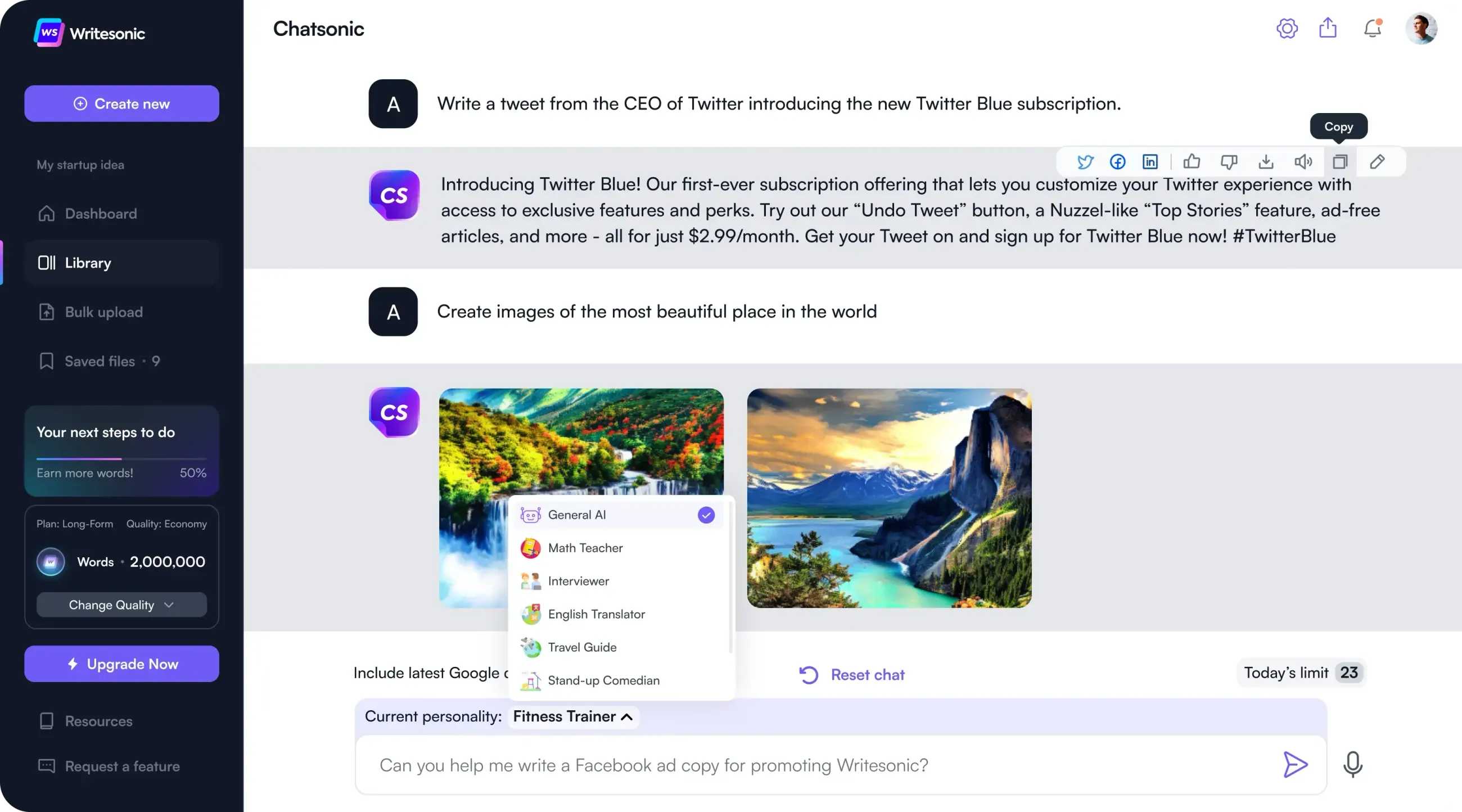
20. ChatSonic: The innovative conversational AI chatbot, such as ChatGPT - Chatsonic (now equipped with GPT-4 capabilities), surpasses the limitations of ChatGPT and emerges as the top free alternative to Chat GPT.
| Key Features | Pros. | Cons | Pricing |
|
|
|
|
https://blog.invgate.com/hubfs/Imported%20sitepage%20images/writesonic-ui.webp
21. Jasper: Google developed Jasper, an advanced conversational AI highly skilled in holding natural and contextually rich conversations. Structured outputs in deep learning are employed to comprehend and address complicated questions, proving to be a valuable asset for interactive purposes like customer support and virtual aides.
| Key Features | Pros. | Cons | Pricing |
|
|
|
|
Benefits and applications of generative AI tools
The advantages of Generative AI tools are diverse and are used in different sectors, thereby revolutionizing the artificial intelligence landscape. Generative AI tools enhance efficiency and decrease labor costs by automating content creation, data generation, and other tasks. They additionally boost precision by minimizing mistakes and partiality in data, text, and images, and magnify imagination by creating fresh and inventive concepts, artwork, music, and writing. Furthermore, they offer the ability to scale up rapidly by producing extensive volumes of data, content, or designs.
If you start exploring the diverse uses of AI, you’ll find that it is being used in fields like art and design, data science, content creation, marketing and advertising, healthcare, education, software development, and research. For example, they are able to produce art, music, and videos, make synthetic data for model training, compose articles and social media posts, generate tailored ads and product descriptions, produce synthetic medical images, develop custom learning materials, create code, and forecast research results. As generative AI tools are evolving and getting better, their advantages and uses are also growing, making them an important part for both businesses and individuals.
ChatGPT, DALL-E, and Generative Adversarial Networks (GANs) are among the top generative AI tools that are revolutionizing multiple industries. As the number of these generative AI tools is continuously increasing, it's crucial to be informed about the newest advancements in order to make the most of their capabilities.
What are the risks of gen AI tools?
The dangers linked to generative AI tools such as ChatGPT are substantial and constantly changing.
Important risks of GenAI Tools to watch out for:
- Absence of openness and uncertainty
- False and made-up results
- Prejudice in results
- Violation of intellectual property and copyright
- Security breaches and fraudulent attacks
- Sustainability and ecological footprint
In order to reduce these risks, companies should put in place measures and regulations to guarantee precision, identify prejudices, safeguard intellectual assets, and prepare themselves for cyber threats. Furthermore, selecting suppliers that prioritize sustainability and renewable energy can aid in decreasing the environmental footprint.

How can businesses use generative AI tools?
Generative AI offers businesses the chance to boost revenue, cut costs, improve productivity, and manage risks effectively. These opportunities can be classified into three different areas as per their analysis.
Revenue Opportunities:
- Through product development, Generative AI allows for quick production of fresh products like pharmaceuticals, cleaning solutions, scents, tastes, metals, and diagnostic instruments.
- Enterprises that have achieved high levels of AI maturity will see increased revenue opportunities from alternative channels.
Cost and Productivity Opportunities:
- Worker augmentation through generative AI improves worker skills in drafting, editing, summarizing, and creating content, code, and chatbot performance.
- AI collaboration enhances employee skills and broadens their capabilities, boosting long-term Talent Optimization.
- Generative AI extracts value from extensive content repositories, revolutionizing workflows.
Risk Opportunities:
- Using Generative AI improves pattern recognition, pinpointing possible risks and reducing them with greater efficiency.
- AI that is generative aids in adhering to sustainability regulations, lessens risks of stranded assets, and incorporates environmentally friendly decision-making in products and processes.
By utilizing generative AI, companies can achieve a competitive edge and unique selling point, fueling growth and prosperity in the near term.
Best practices for using the given list of generative AI tools
Technologies that provide AI trust and transparency will become an important complement to generative AI solutions. Also, executive leaders should follow this guidance for ethical use of LLMs and other generative AI models:
- Start inside: Before using generative AI to create customer- or other external-facing content, test extensively with internal stakeholders and employee use cases. You don’t want hallucinations to harm your business.
- Prize transparency: Be forthcoming with people, whether they be staff, customers or citizens, about the fact that they are interacting with a machine by clearly labeling any conversation multiple times throughout.
- Do your due diligence: Set up processes and guardrails to track biases and other issues of trustworthiness. Do so by validating results and continually testing for the model going off course.
- Address privacy and security concerns: Ensure that sensitive data is neither input nor derived. Confirm with the model provider that this data won’t be used for machine learning beyond your organization.
- Take it slow: Keep functionality in beta for an extended period of time. This helps temper expectations for perfect results.
Some practical examples of generative AI

The field of generative AI will progress rapidly in both scientific discovery and technology commercialization, but use cases are emerging quickly in creative content, content improvement, synthetic data, generative engineering and generative design.
In-use, high-level real world practical applications today include the following.
- Written content augmentation and creation: Producing a “draft” output of text in a desired style and length
- Question answering and discovery: Enabling users to locate answers to input, based on data and prompt information
- Tone: Text manipulation, to soften language or professionalize text
- Summarization: Offering shortened versions of conversations, articles, emails and web pages
- Simplification: Breaking down titles, creating outlines and extracting key content
- Classification of content for specific use cases: Sorting by sentiment, topic, etc.
- Chatbot performance improvement: Bettering “entity” extraction, whole-conversation sentiment classification and generation of journey flows from general descriptions
- Software coding: Code generation, translation, explanation and verification
Emerging use cases with long-term impacts include:
- Creating medical images that show the future development of a disease
- Synthetic data helping augment scarce data, mitigate bias, preserve data privacy and simulate future scenarios
- Applications proactively suggesting additional actions to users and providing them with information
- Legacy code modernization
Future outlook with generative AI products

Most of the people in business are content creators of one sort or another. Their jobs will be dramatically changed by generative AI if it is dealing with text, image, hardware designs, music, or video. They will shift to being a content editor rather than a content creator, which is an entirely different type of skill.
Meanwhile, how the workforce works with apps will change due to their conversational, proactive, and interactive nature—all requiring a new user experience. In more immediate terms, generative AI models will rapidly move from responding to natural language queries to actually suggesting things you didn't ask for. For example, your request for a data-driven bar chart might be answered with alternative graphics the model suspects you could use.
The productivity of workers will at least theoretically be increased, but this also challenges some of the conventional thinking about needing humans to take the lead on developing strategy. The net change in workforce will swing dramatically depending on factors such as industry, location, size, and offerings of the enterprise. Visit our blog on Future of AI for a deeper understanding and boost your career in AI.
Artificial Intelligence Certification Training
- No cost for a Demo Class
- Industry Expert as your Trainer
- Available as per your schedule
- Customer Support Available

Conclusion
Generative AI has clearly brought about a new era of opportunities in which machines are imitating human behavior and playing an active role in creative endeavors. The tools and platforms mentioned in this blog showcase the impressive advancements in technology, from creating code snippets to making music and crafting visual content.
Recognizing the potential and limitations of generative AI is crucial as we advance, acknowledging its power while also realizing the importance of human oversight and refinement. These 21 innovative generative AI tools are helping industries reach new levels of efficiency, creativity, and innovation along with creating more job opportunities for certified AI professionals and AI engineers with high salaries.
If you're eager to learn more about the lucrative world of AI and receive effective training on AI, please contact us by phone or leave a comment with your thoughts on this blog or any additional insights on AI tools you'd like to share. Our experts will respond promptly and help guide you in the right direction. Till then, happy reading!
FAQ’s
1. What are the different types of AI tools used in business?
Types of AI tools in business include generative AI tools, predictive analytics tools, automation tools, natural language processing tools, and computer vision tools.
2. How can businesses integrate generative AI tools into their workflows?
Businesses can use platforms like Zapier to connect generative AI tools with other applications, enhancing workflows and productivity.
3. What are the benefits of using generative AI tools in business?
Benefits of AI include enhanced creativity, time savings, cost efficiency, scalability, and personalized content creation.
4. What are some examples of generative AI in real-world applications?
Examples of generative AI in the real world include AI-generated email campaigns, automated graphic design, AI-composed music, AI-generated prototypes, and AI-driven chatbots.
5. How do generative AI tools ensure the quality and accuracy of generated content?
Quality and accuracy are ensured through continuous training, validation, feedback loops, and applying guardrails.
6. What are the ethical considerations when using generative AI tools?
Ethical considerations include transparency, addressing bias, protecting privacy, establishing accountability, and ensuring fair use compliance.




 Upcoming Class : September 22